A centralized responsive platform to help residents and visitors in Washington D.C. find park information and events quickly and intuitively.
Category
Govtech, Web Responsive
Year
2025
Role
Research, UX, UI
Introduction
The District of Columbia has a rich variety of parks and community events, but it's controlled by various organiztions.
For residents and visitors, this can be frustrating, as it makes it difficult to find accurate details about locations, amenities, and schedules.
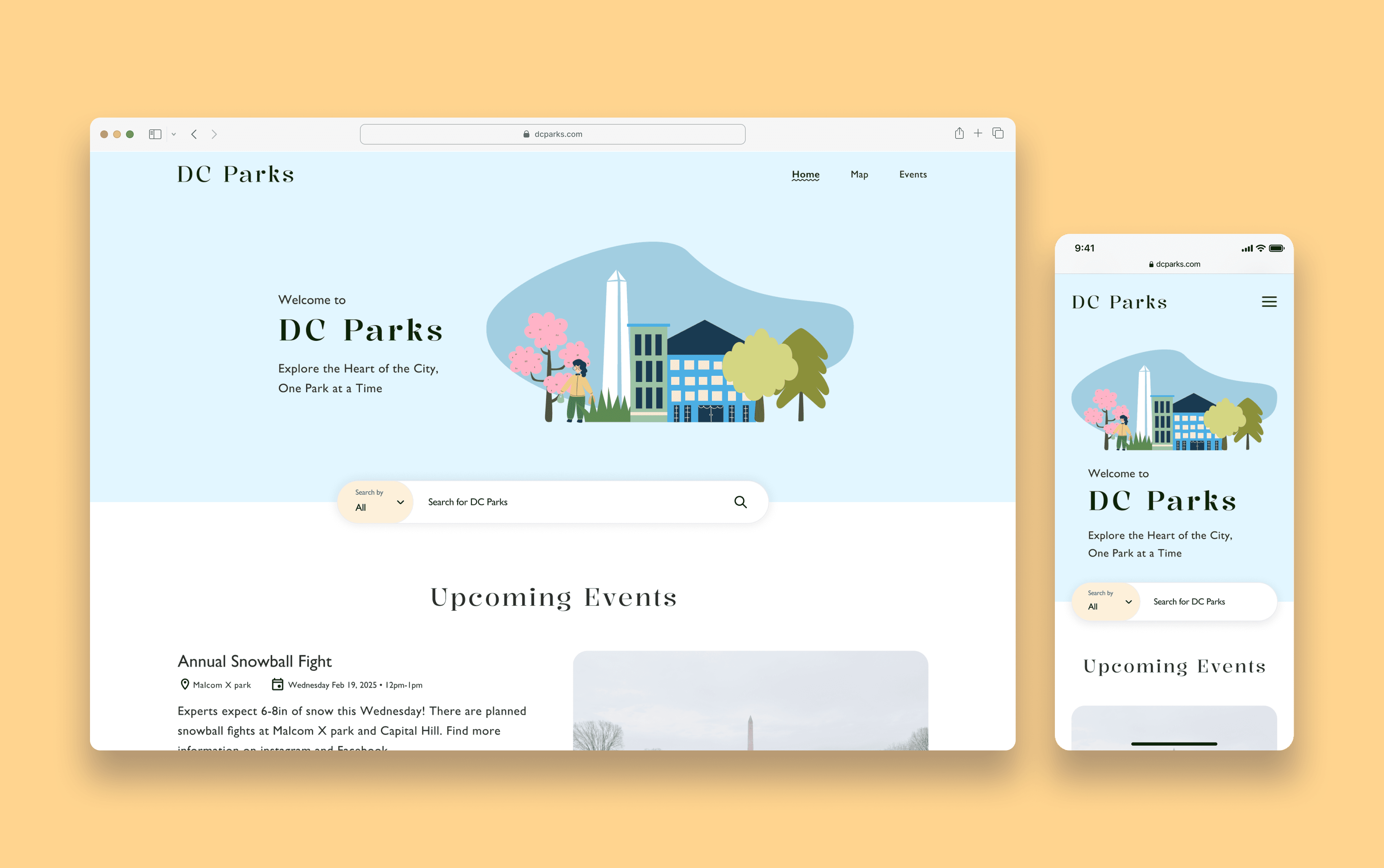
The redesigned DC Parks website consolidates park and event information into one easy-to-navigate platform. It allows users to quickly locate parks, learn about amenities, discover upcoming events, and plan their visits, all from a single, mobile-friendly site.
Problems
Information scattered across multiple federal government and partner sites.
Difficult-to-navigate park websites (e.g., Federal websites with dense information).
Limited mobile-friendliness on key platforms like the National Park Service site.
Lack of detailed, consolidated information on trails, amenities, and park events.
Frustration with finding specific information (e.g., dog restrictions, parking, trail markers).
Research
Participants expressed frustration with fragmented information across federal, local, and third-party platforms.
To understand how D.C. residents and visitors discover, plan, and navigate park visits, I conducted interviews with five participants, three local residents and two frequent visitors, with a range of park habits and motivations. Across all interviews, users expressed frustration with fragmented information scattered across federal, local, and third-party sites, making simple tasks like checking hours, amenities, or dog policies unnecessarily time-consuming.
Participants like Danielle and Sam described struggling with “too many tabs” and “not knowing which site to trust,” while frequent visitors like Helene relied on Google Maps and Reddit because official websites felt outdated or hard to navigate.
By comparing these findings with audits of the National Park Service site, AllTrails, and Google Maps, recurring gaps became clear: limited mobile support, inconsistent content, lack of real-time updates, and no single hub for park and event information.
Personas
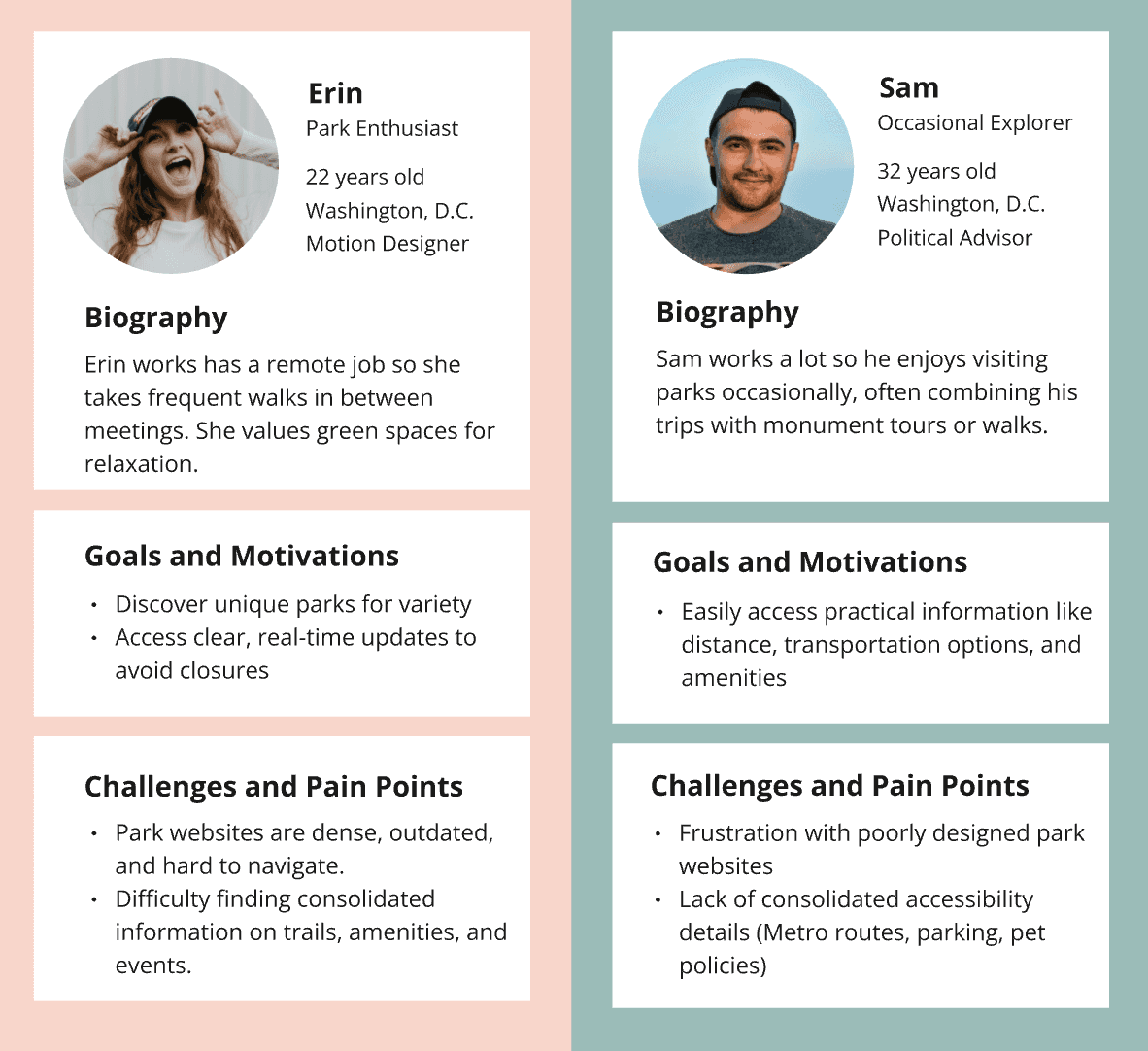
Personas clarified that users need a simpler and more reliable park experience.
From creating Erin and Sam’s personas, I learned that users fall into two main groups: frequent park-goers seeking variety and updates, and occasional visitors needing clear logistical details.
Both struggle with fragmented and outdated park information, making it hard to plan visits. These insights showed the importance of designing a centralized, easy-to-navigate platform that brings all park details together.
Synthesis
Without a single, user-friendly source for park and event information, residents and visitors waste time searching across multiple channels, sometimes missing out on activities entirely.
Research and usability testing confirmed that D.C. residents like Erin and Sam often spend too much time searching across scattered websites for simple park details or event updates. Erin shared that “it’s hard to know what’s happening nearby without digging through multiple pages,” while Sam noted frustration with “not knowing which parks are open or Metro-accessible.”
These findings emphasized the need for a single, centralized platform that simplifies discovery and supports quick decision-making. Users also expressed that mobile access was critical since most planning happens spontaneously while commuting or walking.
How might we:
Make it easy to find park and event info in one place?
Support quick decision-making for visits?
Ensure the platform is mobile-friendly for on-the-go planning?
Features
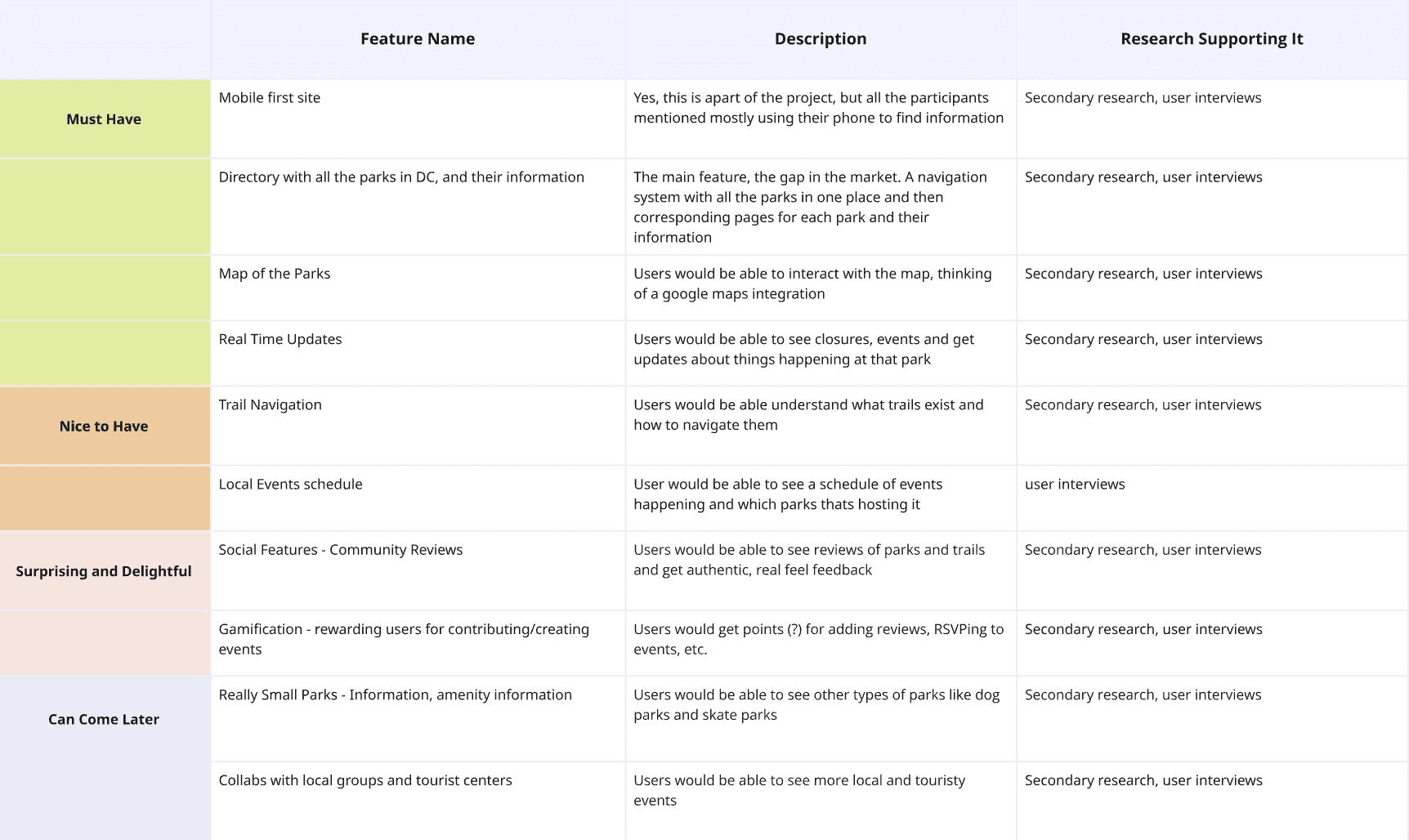
Prioritization focused on solving users’ biggest pain points first: easy access, clarity, and reliable park information.
The product requirements were prioritized based on user interviews and research findings that highlighted the need for a mobile-first, centralized platform to access park information. Core features like the park directory, interactive map, and real-time updates were classified as “must-haves” because users consistently expressed frustration with scattered and outdated resources.
Secondary features such as trail navigation and event schedules were categorized as “nice to have,” enhancing usability without compromising simplicity.
Task Flow
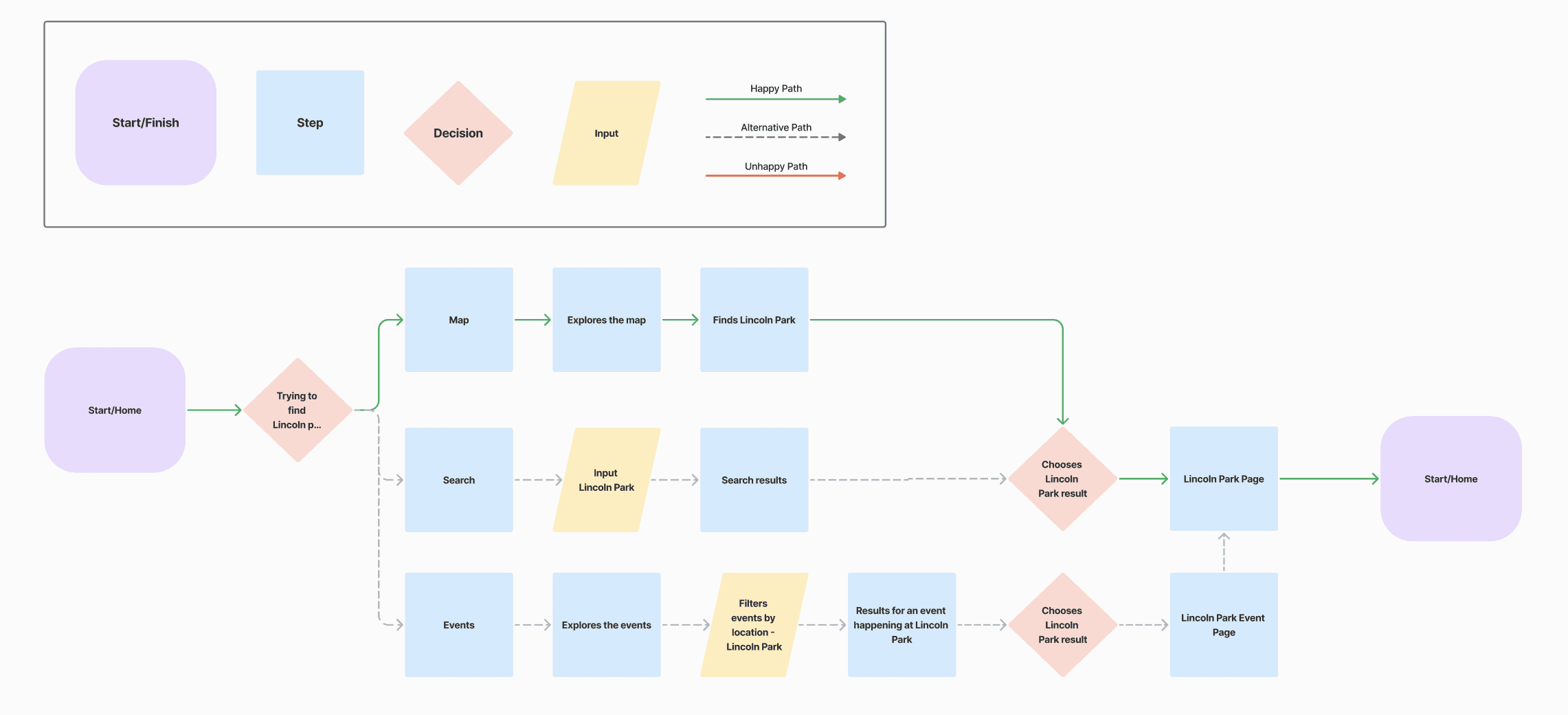
Refined flows create a more intuitive, low-effort experience that helps users quickly find what they came for.
The user and task flows were designed to minimize friction, ensuring visitors can reach key information, like park details, amenities, and events, with as few clicks as possible. Using clear flow diagrams, I mapped how users move from the homepage to park and event pages.
These flows were informed by prior research showing that users often get frustrated navigating dense, inconsistent park websites. The testing and flow review revealed opportunities to simplify navigation labels, reduce redundant paths, and highlight high-priority content above the fold.
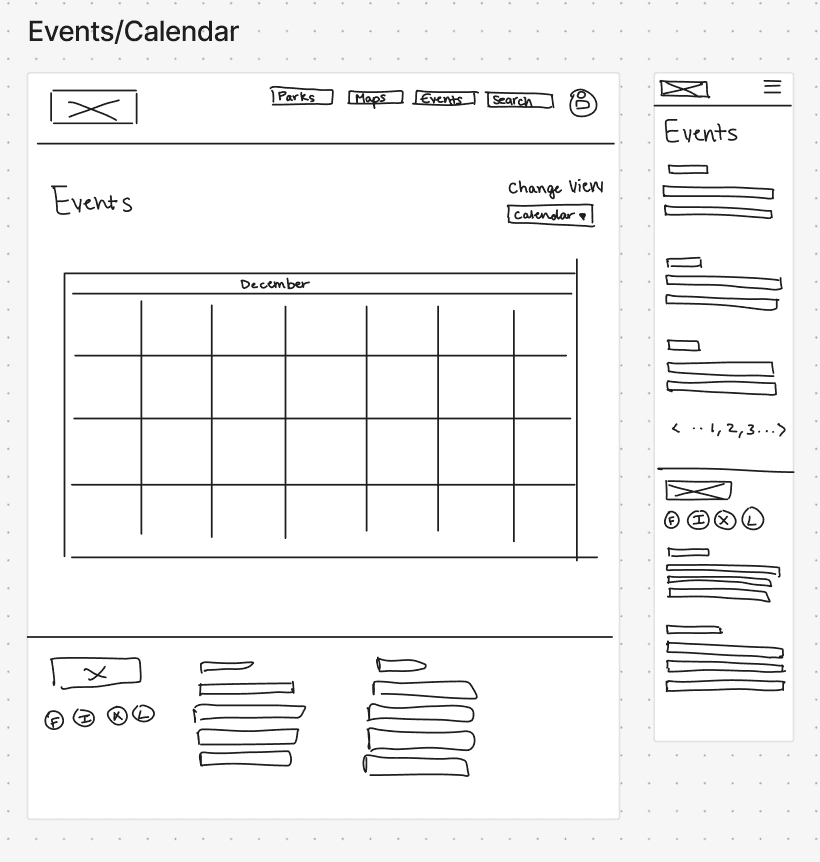
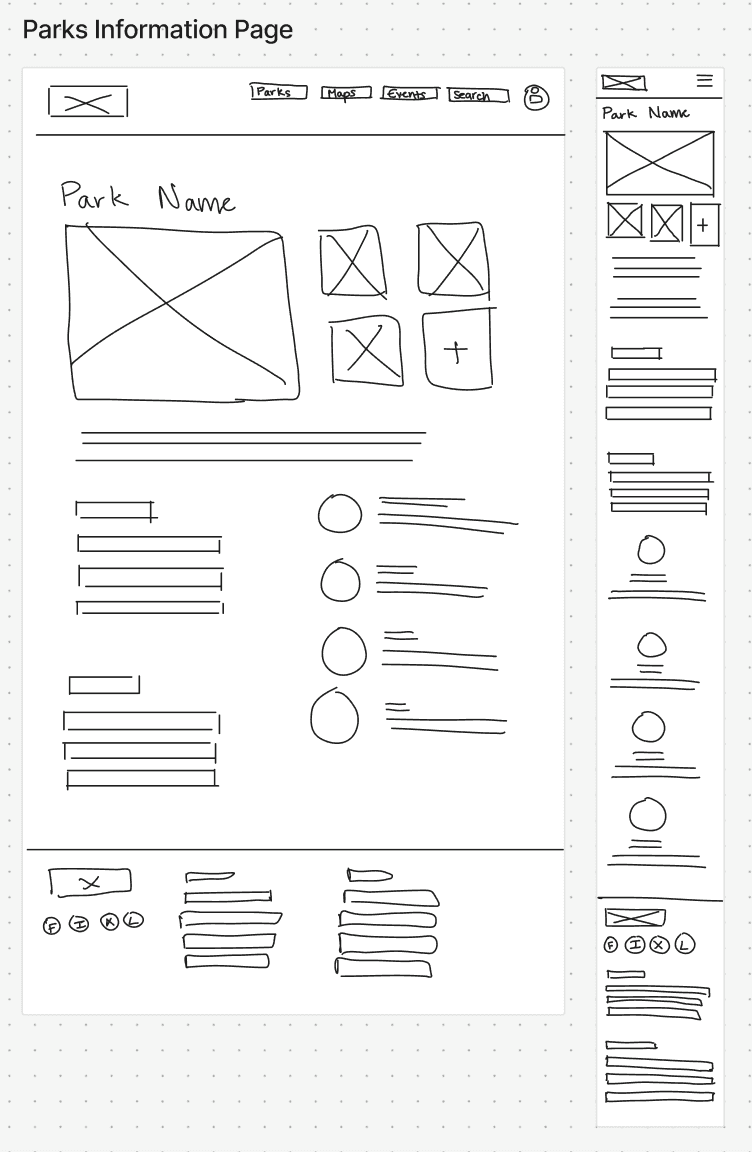
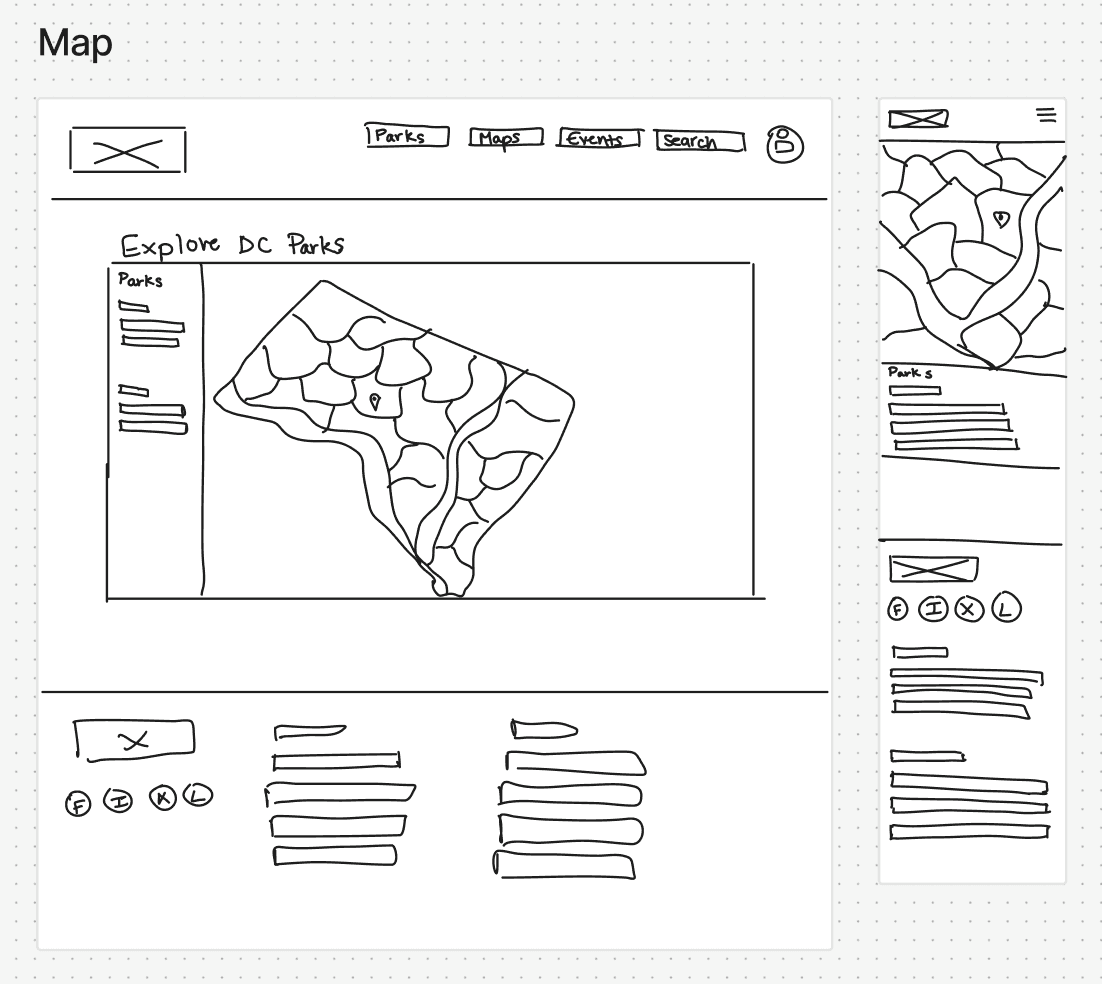
Lo-FI
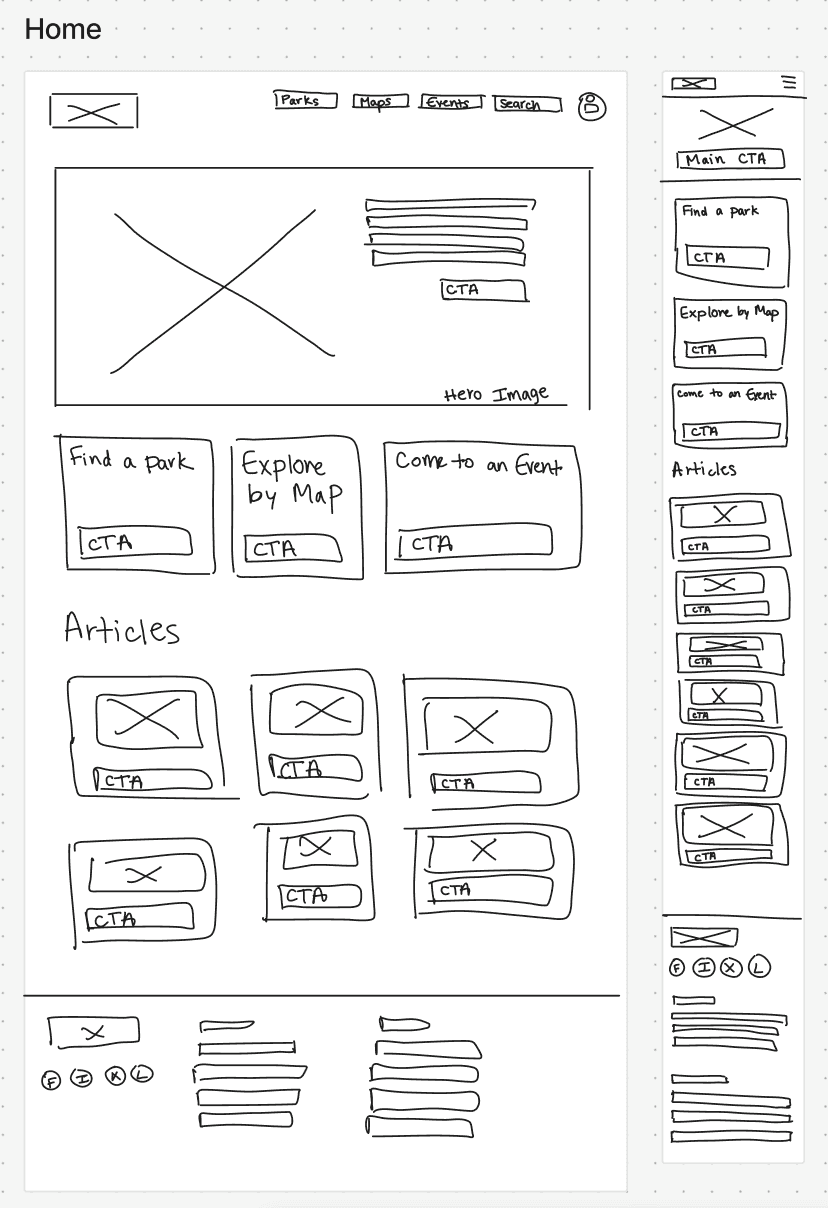
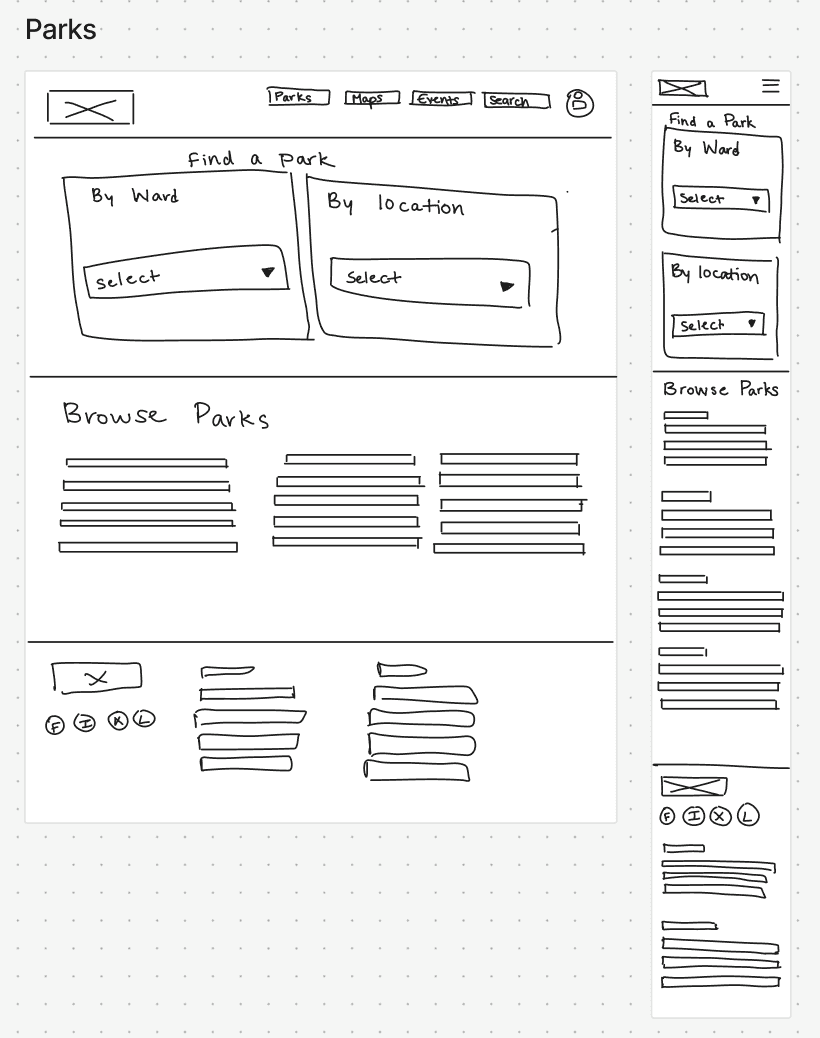
The wireframes evolved through iteration to create a clear, user-centered layout that made essential park information accessible at a glance.
In developing the wireframes, I explored multiple layouts to balance high-priority content with clarity and ease of navigation.
Since users often compare park platforms to Google Maps, the challenge was to present detailed information, like location, amenities, and events, without overwhelming the screen. I designed and iterated on at least five key screens, including the homepage, park directory, park detail, event listing, and event detail pages, to test a complete end-to-end flow.
Each element and annotation was thoughtfully considered to ensure minimal clicks from the homepage to core content, maintaining consistent structure and readability across devices.
Branding
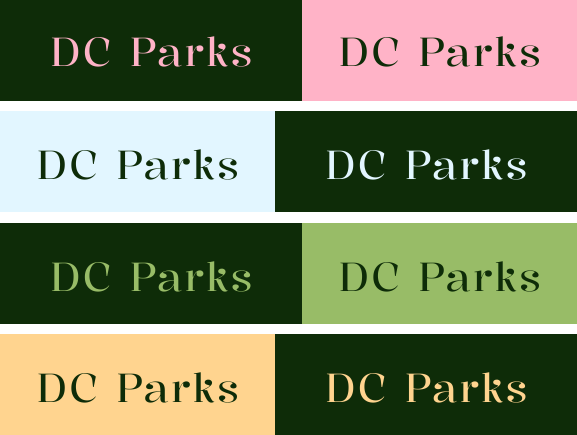
The branding communicates trust, connection, and the natural spirit of D.C. parks.
The DC Parks branding was designed to reflect accessibility, community, and nature through a clean, modern logo that resonates with both locals and visitors.
The color palette draws inspiration from D.C.’s green spaces and waterways, creating a calm yet vibrant feel. The logo is flexible and scalable, ensuring clarity across digital and print formats.
UI Exploration
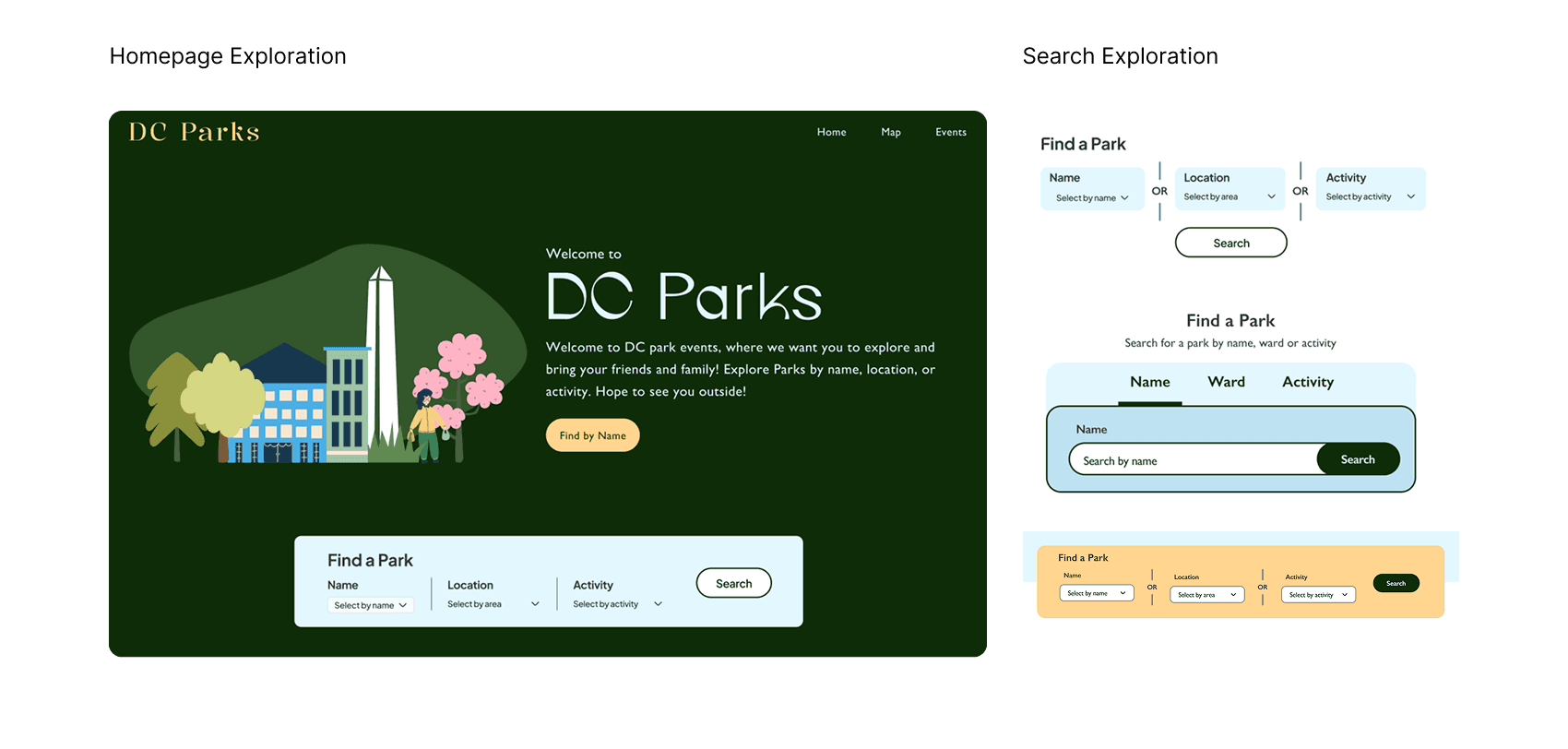
A more playful design system was developed to contrast the rigid government websites.
The visual design intentionally moved away from the rigid, formal aesthetic of government websites, evolving through multiple iterations to create a more playful and approachable system. One of the most refined components was the homepage search feature, where I explored different layouts and interactions inspired by Airbnb and AllTrails to allow users to type a query or quickly select a filter from a dropdown.
These iterations focused on balancing friendliness with clarity, ensuring the search experience felt intuitive, fast, and aligned with the brand’s lighter, more welcoming direction. The final visual style, featuring soft shapes, clean spacing, and accessible typography, was grounded in the project’s art direction and user research, emphasizing ease, warmth, and visual clarity across devices.
HiFi Designs
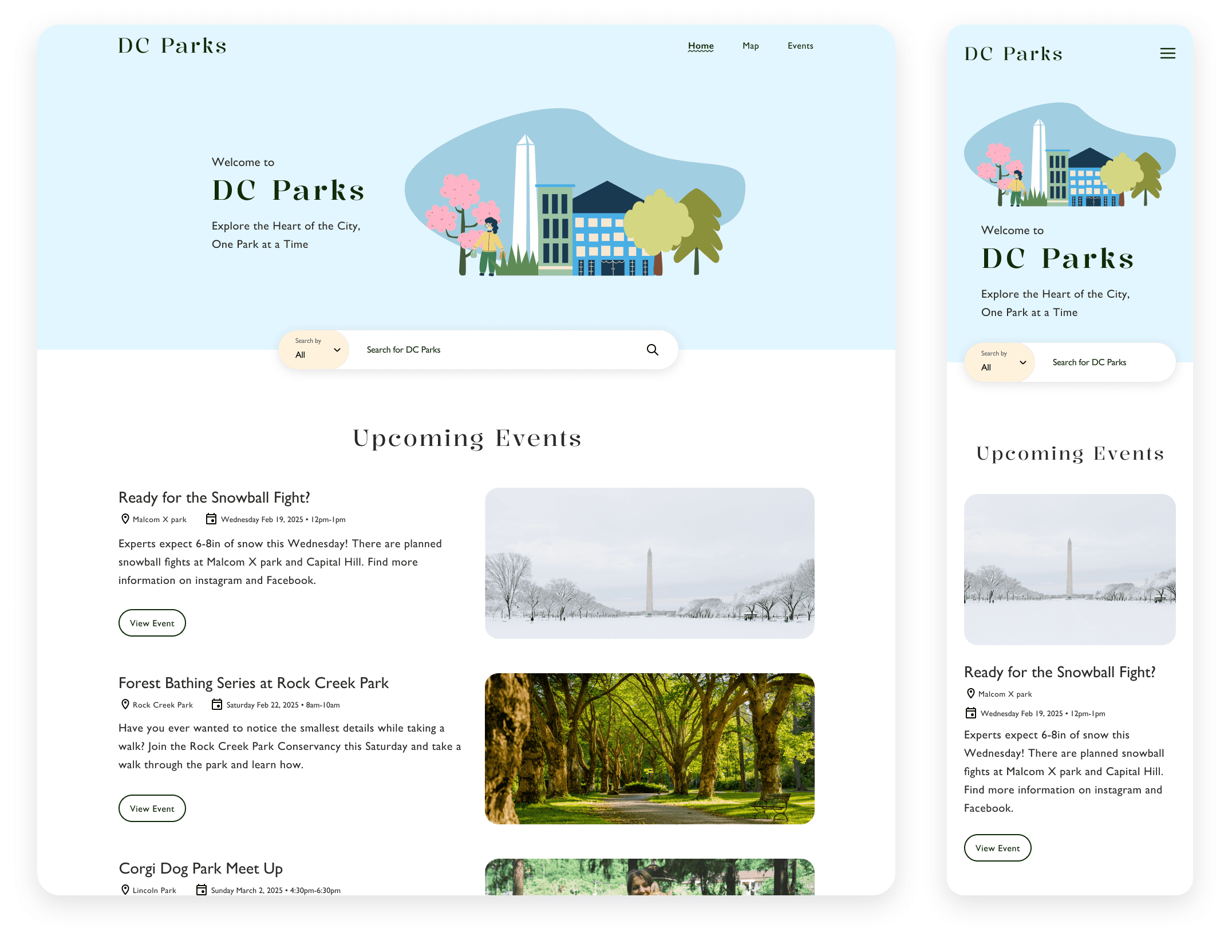
Thoughtful visual structure and iteration transformed usability into an approachable, on-the-go park experience.
The homepage became a central touchpoint for engagement, designed to spark exploration from the moment users arrive. To encourage discovery beyond their usual parks, featured events were placed directly on the homepage, offering seasonal highlights, family-friendly happenings, and nearby activities. This decision reflected user feedback that event information is often hard to find and scattered across multiple sources. By surfacing events early, the design helps residents make quicker decisions and creates a more dynamic, welcoming entry point into the platform.
The design decisions, like high-contrast visuals for outdoor readability and mobile responsiveness, were guided by user research insights and the brand’s goal of making D.C.’s parks feel open, engaging, and easy to explore.
HiFi Designs
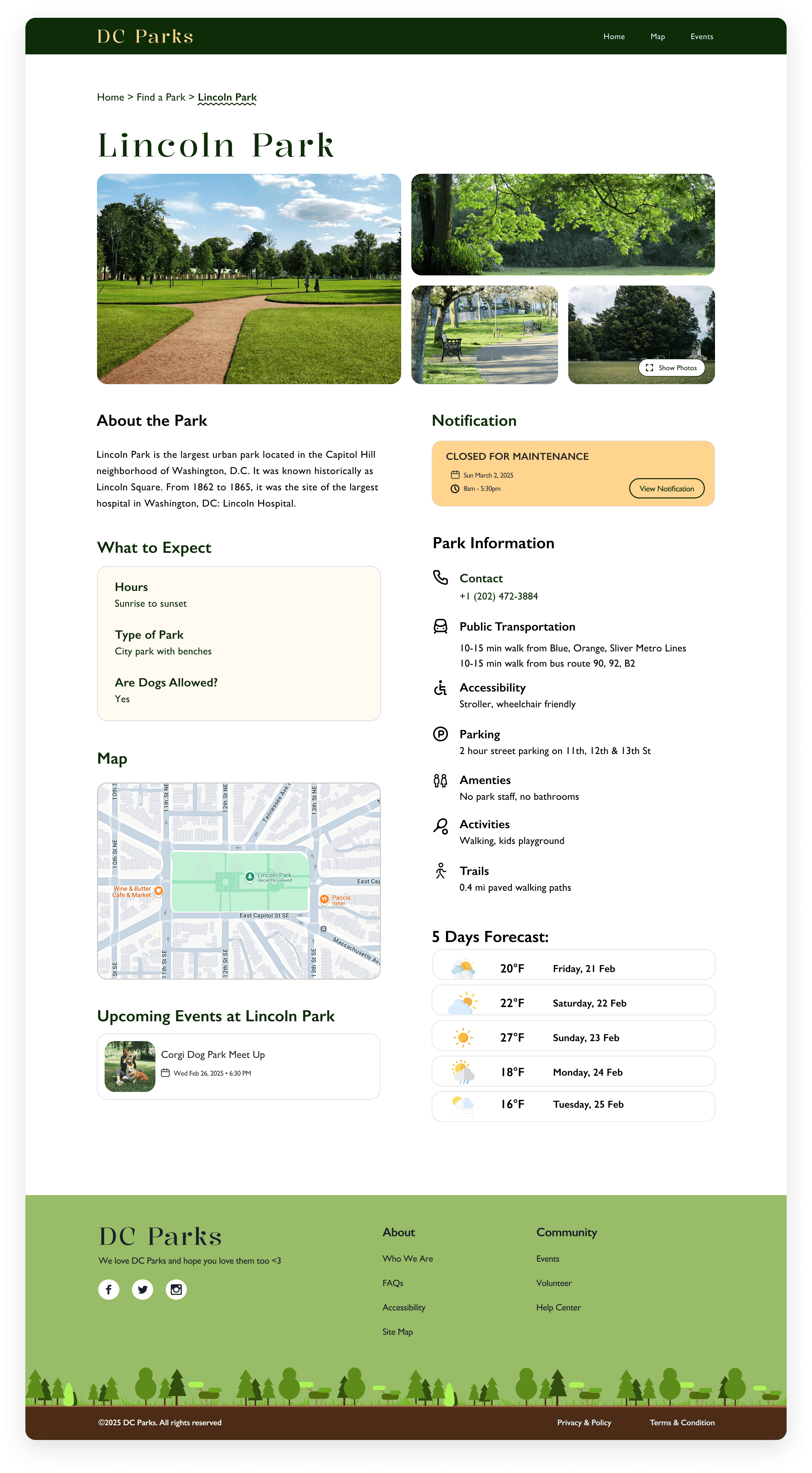
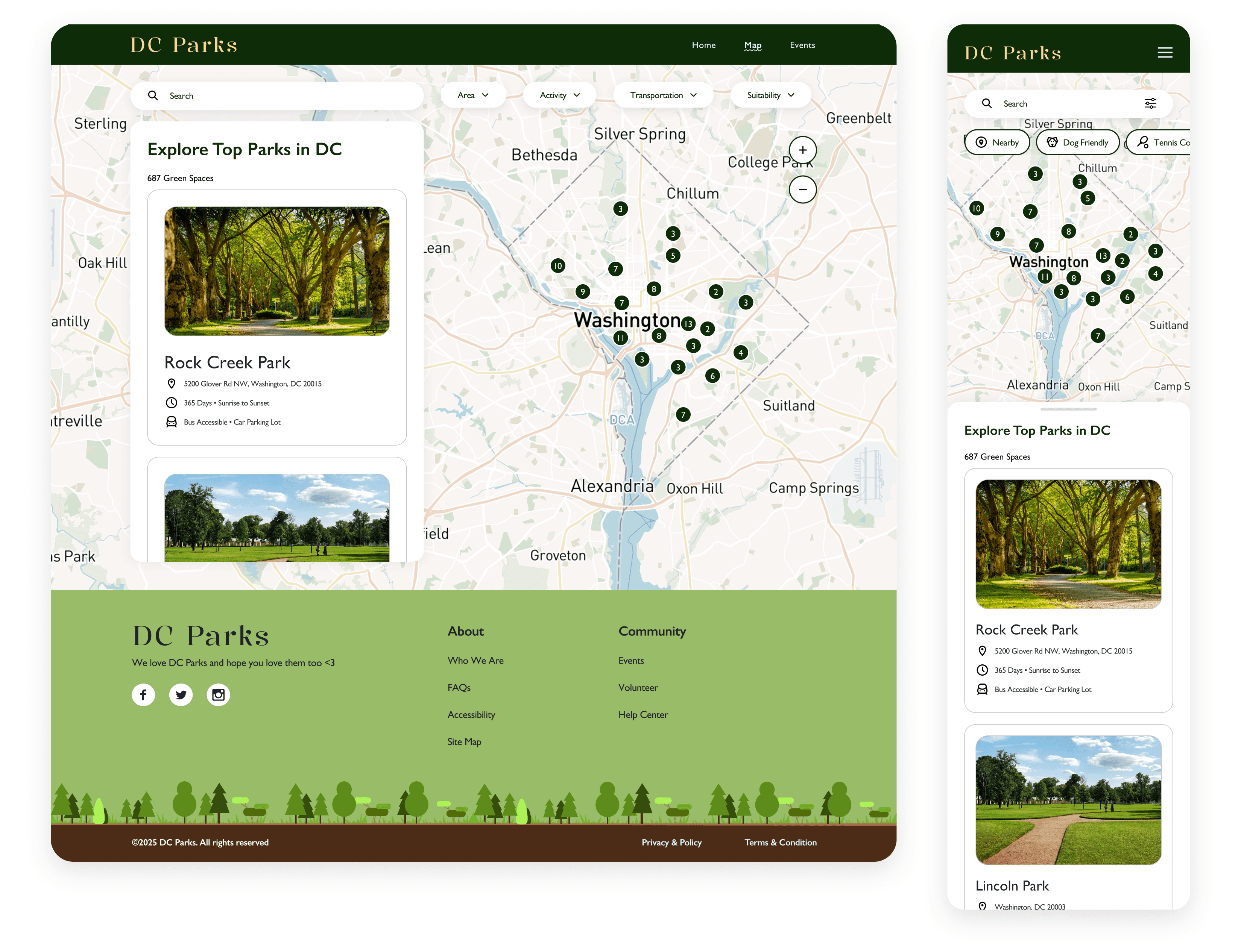
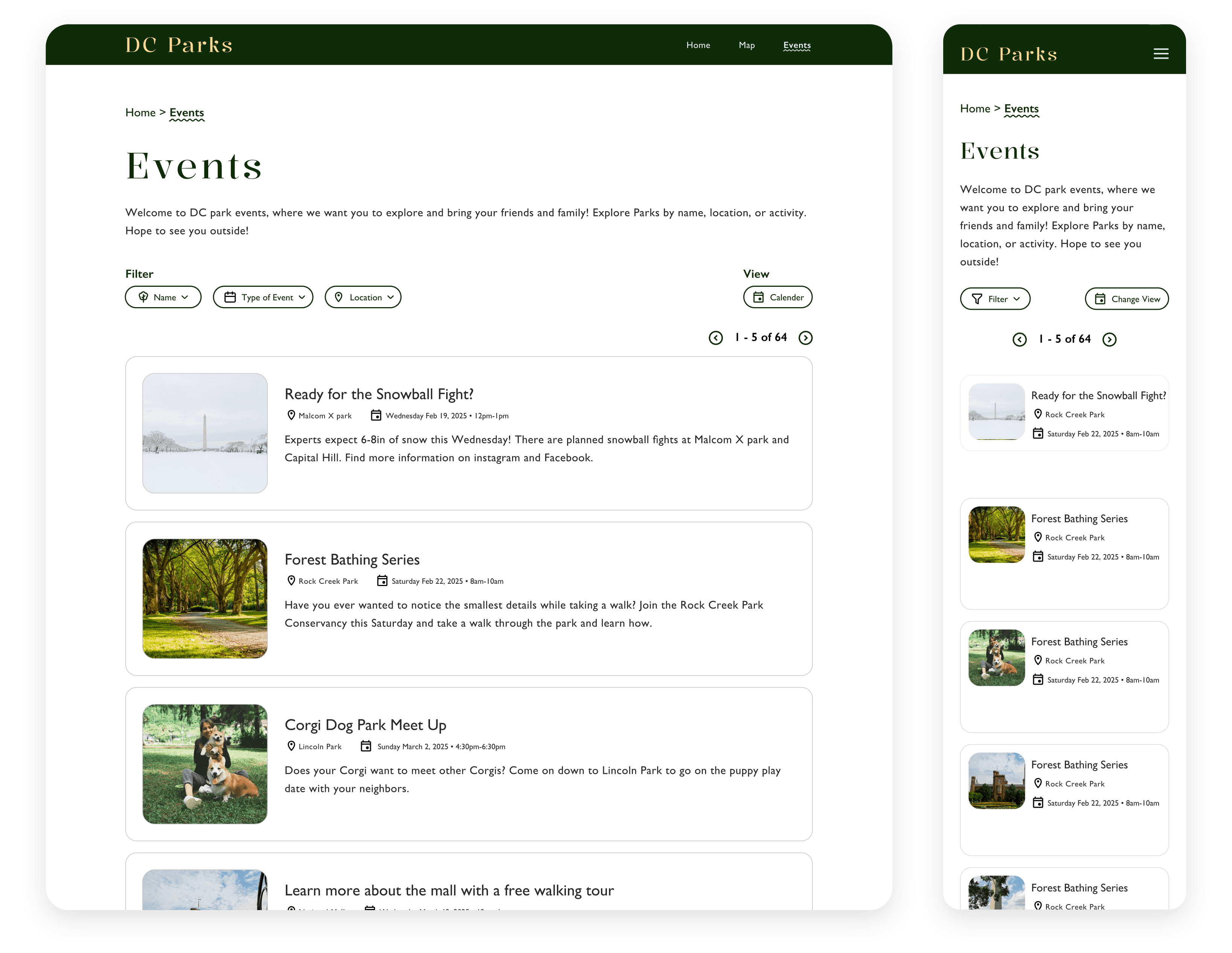
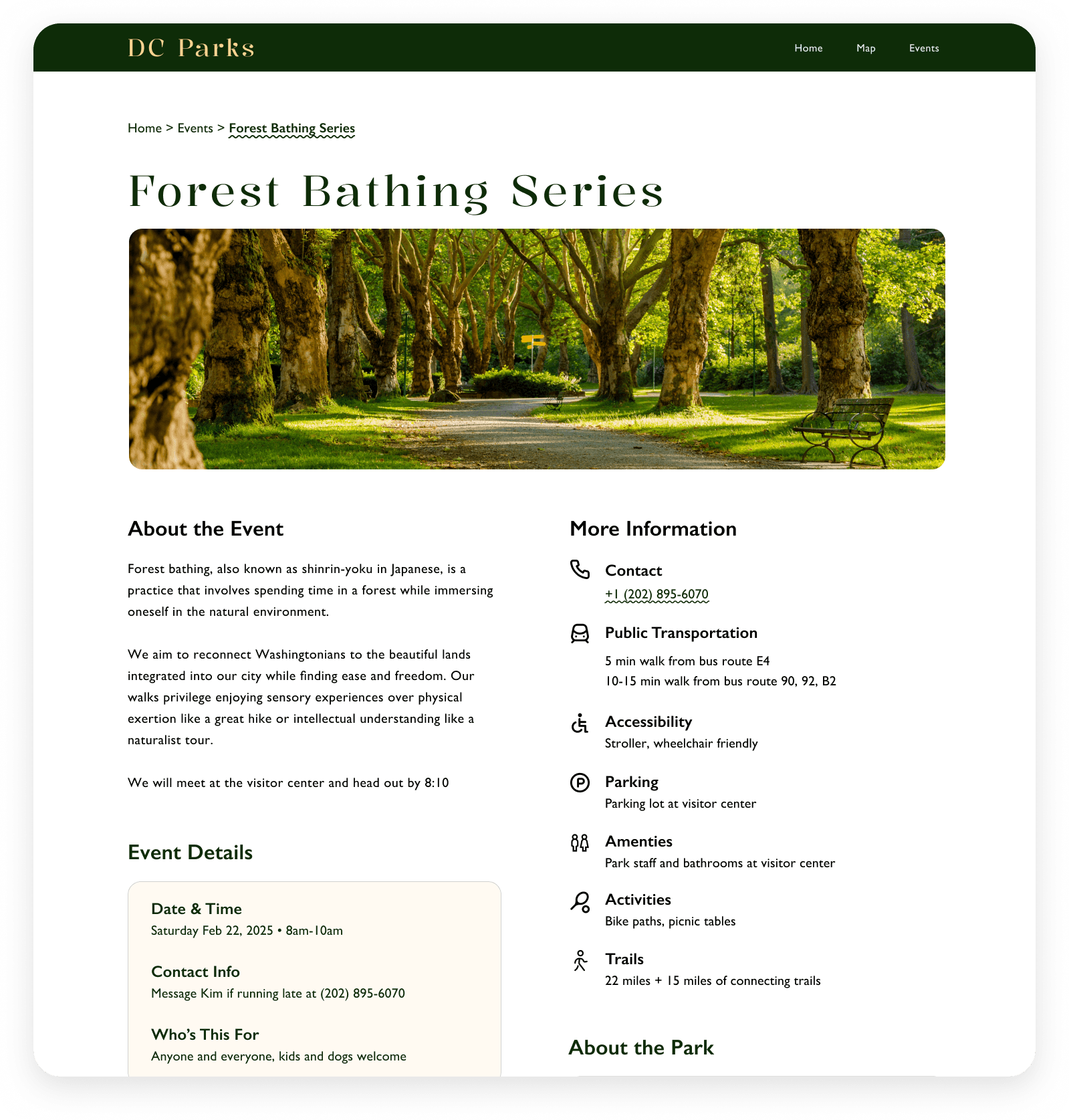
The Parks Info Page became a central example, balancing accessibility and clarity through structured layouts, readable typography, and intuitive navigation. Key screens such as the homepage, park directory, event listing, and park detail pages were refined to maintain visual consistency while ensuring users could access essential information quickly.
The other pages like the parks map, event listing, event detail page, and supporting navigation screens, were developed to test a complete and intuitive user flow. Each wireframe was annotated to clarify the purpose of every block, ensuring content hierarchy remained consistent and easy to follow. High-contrast visuals, responsive layouts, and clear typography were intentionally chosen to support users planning visits outdoors and on mobile devices, aligning with research insights about how D.C. residents discover parks on the go.
Usablilty Testing
User testing directly shaped a more intuitive, streamlined experience that made key park information easier to find.
Usability testing was conducted with five participants, representing both frequent park-goers and occasional visitors to ensure a balanced perspective. While users consistently praised the clean, modern layout and overall visual clarity, the sessions revealed key areas for improvement.
Several participants struggled to locate important information like hours, because the alert caught thier eye to fast. Additional observations showed that users relied heavily on mobile devices, reinforcing the need for stronger mobile-first patterns. These insights uncovered opportunities to streamline content placement, enhance labeling, and improve the visibility of interactive elements to support faster decision-making.
Revisions
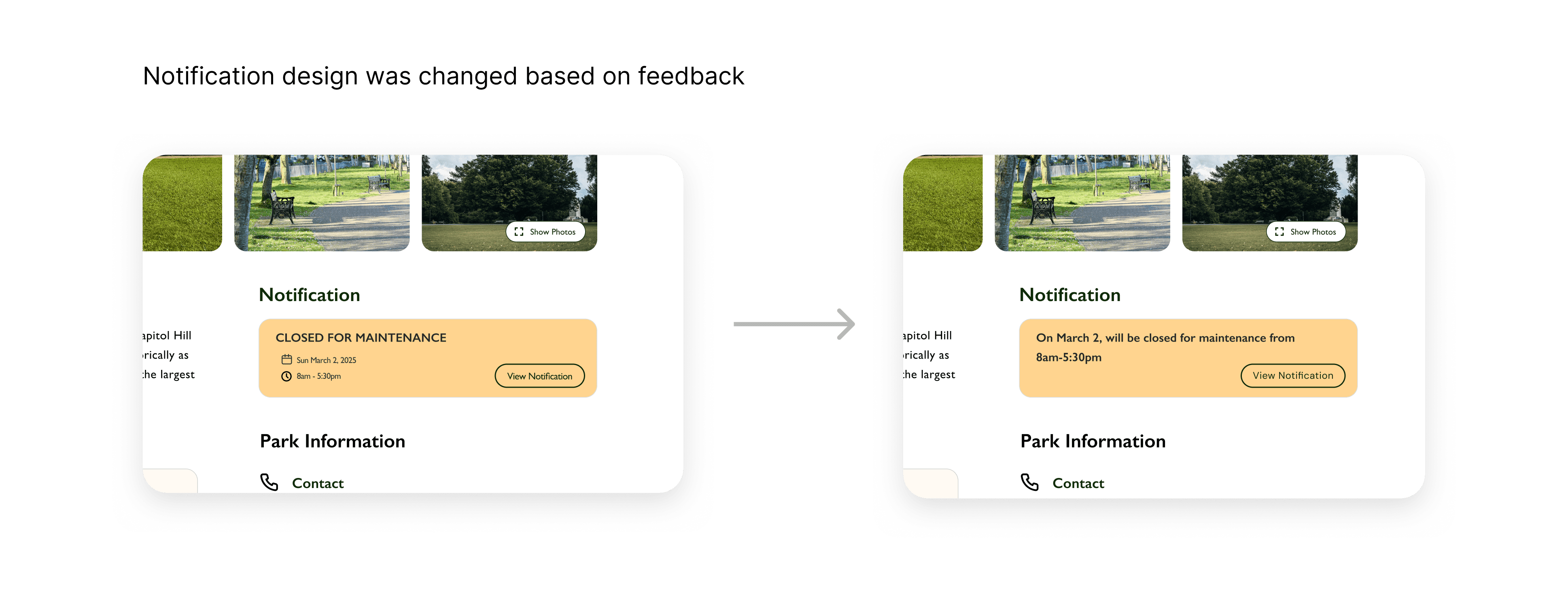
Users thought the park was closed based on the notification design.
User testing uncovered a critical issue: several participants mistakenly believed a park was closed because the notification banner appeared too prominent and visually resembled a closure alert. Since this misunderstanding directly affected users’ ability to trust the information, it became a top priority for revision.
The notification design was reworked to clarify, iconography and typography to distinguish between general updates and actual closures.
Summary
By centralizing park and event information and streamlining navigation, the platform improves how both residents and visitors interact with DC’s outdoor spaces.
Looking back, this project strengthened my understanding of how thoughtful design can simplify civic experiences. As a designer, I learned the importance of grounding every decision in real user needs—balancing accessibility, usability, and visual clarity to make public information more approachable. The platform successfully centralized park and event details, streamlining how residents and visitors engage with D.C.’s green spaces.
Next Steps:
Integrate accessibility and transportation details into all park and event pages
Add event filtering for faster discovery
Expand mobile-first optimizations for users planning visits on the go
In short, this project reaffirmed that clear navigation and responsive design are essential for building civic tools that genuinely serve their communities.